

In Exile: The Lives of Queer People in Kashmir - Storytelling Initiative - third edition
In Exile: The Lives of Queer People in Kashmir
In Exile: The Lives of Queer People in Kashmir is a reported long-form narrative that traces the lives of transgender and queer individuals in Srinagar and nearby towns. Moving through the lanes of Dalgate, roadside quarters in Budgam, quiet cafés, courtrooms and the of the Jhelum river, the project documents lives shaped by rejection, faith, conflict and conditional belonging. It also examines what it means to claim identity in a place where visibility can invite danger. At its centre are individuals who face exclusion from family, faith spaces and public life, yet continue to assert their humanity through small but deliberate acts of endurance.
In the winter of 2015, Ahmed, better known in Dalgate as ‘Mama’, passed away at the age of 90. Mama was denied burial in the graveyard nearby. Locals opposed it vehemently, claiming, “His body will bring trouble for the other dead in the graveyard.”
Left with no other option, Mama’s transgender friends elsewhere in Srinagar pooled their resources, raised Rs. 20,000, and bought a piece of land to bury him. He was laid to rest beneath a tree on an abandoned plot, outside the graveyard’s boundaries a day later. His funeral was a quiet affair, with just two people attending it. No family members came. His brothers refused to stand at his grave.
The willow tree, now in bloom on an August afternoon, has cast its shadow on the grave. Shabnam, a transgender woman from Dalgate, Srinagar, recounts Mama’s story in bits and pauses, coughing between sentences. Twenty years before he died, Mama had been thrown out of his home and later lived in a tin shed in the outskirts of the city. In his youth, Mama lived off singing at weddings (a practice he deplored), but as he grew older and his health started to deteriorate, he was forced to beg.
“It seems to me he was only born for the purpose of begging,” Shabnam sighs. “Sometimes, I am afraid the same fate might be waiting for me. Who is going to bury me!” Shabnam laments. When Mama died, those who had disowned him suddenly appeared. “A few days after his death,” Shabnam says, “they came to his home and took everything that belonged to him, cash, jewellery, musical instruments.”
Shabnam
Shabnam had come to pay obeisance to her friend. She squats beside the mound, smooths the grass with her palms. She meticulously examines the grave for any cracks on the edges. Standing beside the tombstone, Shabnam raises her hands and prays. For months after Mama’s death, Shabnam didn’t sing or go to weddings. “I come here often, especially on Fridays, to pray,” she says as we walk back. “And on the days I miss him, I still feel he is my last friend.”
Shabnam is afraid that her life will be a rerun of Mama’s. Shabnam knows no way of earning other than singing at weddings and match-making. She has bought a small plot of land and has opened a modest savings account — insurance against the hardships and loneliness ahead.
She has a framed photograph of Mama on the wall of her room near Dal Lake. The lanes leading to her house are narrow, flanked by tall, old, crumbling houses. The scooters squeeze past, and as Shabnam walks ahead of me, a few shopkeepers smile sheepishly. As we walk, the lane thins out to a narrow drain that overflows with stagnant water, faeces and urine.
It’s a sultry day. Inside Shabnam’s room, it takes my eyes time to adjust to the darkness. The dim room is part of a larger apartment occupied by migrant workers from India. Shabnam turns on the light and sits down. “This is my life’s earnings,” she says, sitting down. “One small room, and a small kitchen you can hardly call one.”
Shabnam remembers. “I came to the city 20 years ago, alone, tattered, and hungry. Now I own a small place but at least I have a place.” Tears trickle down Shabnam’s face. “I knew Mama from the time I didn't have a place to go to,” Mama was more than a friend, he was almost her father. Their destinies had crossed years ago when Mama gave shelter to a 20-year-old from Sopore.
Shabnam’s voice is calm when she speaks of what she endured at home, as if it happened to someone else. She recounts years of physical abuse from her family, including an incident when her brother broke her arm and locked her in a room for days. Rolling her sleeves up, Shabnam shows me the remaining memory, a scar, a charred leech remaining to make her remember the days. Her brother twisted her left arm, and pushed her, breaking the arm. Shabnam tells me that her left arm remains broken.
“I did not speak up. I thought I deserved it. Maybe there was something wrong with me.” When the violence escalated, Shabnam confronted her family. That led to her permanent expulsion. “My family even took away my clothes. I was thrown out with nothing. I spent days starving,” she says.
In Srinagar, she eventually joined a troupe of transgender musicians, who were also traditional match-makers. After she started earning, she began sending part of her savings to her sisters. “I have two sisters. They were unmarried at the time. I felt responsible to support them and save money for their weddings. I managed to send them money, but I didn’t attend their marriage ceremonies,” she says.
Shabnam’s education had ended after the fifth grade. Persistent teasing, hooting, and name calling in school had forced her to drop out. “I wish I had been able to study. I would have loved to become a teacher. I do not like the job I am doing, it is humiliating, and people do not respect it. There are times when people do not even want to look at you. They think we are not human. We live a life of humiliation.”
Jameela
Like Shabnam, Jameela’s early life was marked by rejection, exclusion, and the harsh judgment of those closest to her.
At 17, she was forced out into the world with nothing but fear and a few rupees in her pocket. Jameela recalls. “I had dressed up in my sister-in-law’s clothes one day. When my brother saw me, he threw me out.” The home that should have been a place of safety became a source of pain, leaving her to navigate survival on her own, she says. “It was winter, and it was cold.”
Today, at 50, Jameela is self-assured. She lives alone in a rented room in the outskirts of Budgam town. When she first came to Srinagar, she was illiterate, frightened and had nowhere to go. “I resolved to live. I went to Dastagir Sahib and prayed. He gave me shelter.” She began begging at the shrine. The year was 1995, and Srinagar was mired in an armed conflict between militant groups and Indian armed forces; gun battles and protests were a regular feature. Jameela remembers the fear she felt walking along the roads brimming with soldiers, policemen, trucks and jeeps. She felt that fear again years later in 2019 when Srinagar was put under curfew after the abrogation of Article 370. She says with a strong sense of irony that it is her fate to be trapped in curfews.
Back in 1995, she was detained by soldiers after they had seen her around the shrine late in the evening. She was wearing a pheren and had a bag tucked inside, which is what, she says, made her a target. She remembers that day vividly, and after they slapped twice, she was immediately kept apart from others who were detained. She was questioned for two hours. They asked her what she was doing around the shrine. “After they discovered that I am a transwoman, they let me go and told me that I should not be seen around the shrine again” says Jameela.
Taking a friend’s advice, Jameela joined a singing troupe of trans women, stopped going near the shrine, and began performing at wedding ceremonies, singing and dancing. It is the only profession open to many transgender women in Kashmir and it is a profession trans people despise. “I didn’t understand why I had to sing and dance. I knew nothing, but I had no choice. At least it gave me some money,” she says. “Given a choice, I’d never dance. It is a humiliating job. People look down on you. They don’t treat you as humans.” Recollecting those times, Jameela speaks with both sadness and anger. After performing, she and her troupe were not allowed to sit with the guests and had to eat outside. “At first, I thought it was a one-off. But it kept happening. We were treated like dogs,” she says. “And on top of that, families don’t pay us enough. They spend lakhs on the feast but don’t spare a few thousand for us. It is a thankless job.”
For years, Jameela traveled across the Valley, performing with the troupe wherever she could. And she soon found her life getting entangled with the curfews preventing her from going out. Then on August 5, 2019, when the state imposed what another curfew, everything came to a halt. It would turn out to be not yet another curfew. “It was a hard time,” she remembers. “With no one to take care of me, I was living alone. I was frightened.” After two days of hunger, she decided to venture out to buy milk and was accosted by policemen. She finds it baffling that even after so many years she felt the same fear. The street she lived on was closed by a barricade manned by a dozen soldiers. She spent two days hungry, managing on vegetable soup she made out of left-overs.
“It was a horrible time for me. I was not able to contact anyone. I was not able to come out and even buy groceries. Curfew was hard on everyone, but it hits our community doubly, we have no one to lean on,” she says. During the breaks in the curfew she travelled by foot, taking inner roads of the city to finally reach her friend, Naseema. She stayed with Naseema for a month, managing the little money they had.
Jameela says that she was strongly reminded, “Life in Kashmir is uncertain. Anything can happen. You need money to survive.” Jameela had learned tailoring in her teens and when the curfew was lifted, she began working in a tailor shop run by a group of young women. Today, she works in a boutique. Not only is she skilled, but she has an innate sense of fashion and an ability to understand clients’ preferences. “I am at a good place in my life. I earn enough for myself.”
Yet, social interaction remains a longing. Jameela has only ever had one close friend. She dreams of simple pleasures, like going out for tea in a café, without the fear of judgmental stares or comments or soldiers. “I am too afraid. Not everyone is bad,” she says softly, “but some people do make comments or give looks. Sometimes soldiers do that. Policemen too”
For many transgender women in Kashmir, financial insecurity is central to their struggles. For both Shabnam and Jameela, they say, their early experiences of marginalization were not just personal tragedies, they were the beginning of a lifelong struggle to assert their identity, claim dignity, and find a place where they truly belonged.
Aijaz
In the narrow lanes of Srinagar’s Barbashah locality, Dr. Aijaz Ahmad Bund works quietly for the LGBTQ community. His small office is home to the Sonzal Welfare Trust. Sonzal means rainbow in Kashmiri. The Trust is both a refuge and a record of struggle. People come here seeking legal help, support, or simply a listener.
Bund’s journey began in 2011 when a transgender matchmaker visited his home with a proposal for his sister. The unease he witnessed that day made him confront the deep stigma faced by transgender people. “I realised how easily we deny others their right to live with dignity,” he says. That moment led to Kashmir’s first organised movement for transgender rights. He approached the Jammu and Kashmir Social Welfare Department for inclusion of transgender persons in welfare schemes. When ignored, he petitioned the State Human Rights Commission in 2013 and later filed a case in the High Court, arguing that neglecting transgender rights was “institutional discrimination.” In 2017, Bund founded the Sonzal Welfare Trust to offer counselling, legal aid, and livelihood training to the community. “We wanted to create a space that addresses health, housing, and safety,” he explains.
When we meet in his office, Bund sorts through a pile of files — narratives on the lives of queer people — and lays them neatly on the table. He studies them carefully, sitting across from me. “These are the narratives of abuse,” he says, turning the pages with deliberate care. “People’s lives are trapped within these sheets.” It took him years, he explains, to listen to queer people and their stories. When he finally began sorting the material for his writing, he would often sit for hours, brooding over the weight of what he had heard.
Bund’s research paper Other Sex (2013) was among the first studies on transgender life in Srinagar, documenting harassment, social exclusion, and economic marginalisation. His 2017 book Hijras of Kashmir: A Marginalised Form of Personhood expanded on these themes through personal narratives; stories of daily survival and systemic neglect. “The state functions through masculine logic,” Bund notes. “It decides who is seen as worthy of protection.”
“The more I read these stories,” he says quietly, “the stronger my resolve became to help queer people.” Just then, his phone rings. He answers promptly. For five minutes or so, Ajaz listens intently, nodding from time to time. He assures the caller that he will take care of things and hangs up. “A transgender person needs some financial help,” he says, putting his phone aside. “I was talking to a friend of mine to arrange some money.” After the call, Bund walks me out to the main road.
In our conversation, Bund highlights lack of education and property rights as key reasons behind the community’s marginalisation. Most are disowned by their families and forced into matchmaking or singing at weddings for survival. Though the Transgender Persons (Protection of Rights) Act, 2019 exists, implementation remains weak. “Police stations are not safe spaces,” he says. “Complaints are often dismissed.”
In 2024, Bund published Unlocking Closet: Lived Experiences of Kashmiri LGBTQ Muslims, documenting resilience and resistance within the community. Through Sonzal and his continued advocacy, Bund remains one of the few steady voices for LGBTQ rights in Kashmir. “We are still building recognition,” he says. “The next step is turning visibility into rights.” He points out how policies often overlook trans people, such as bus fare schemes limited to women.
Despite the challenges, Bund notes a growing willingness among young lawyers, activists, and some religious scholars to address the issue publicly. “When I began, there was silence,” he says. “Now, clerics speak about the rights of transgender people in sermons, and young people are asking questions. The conversation has begun.”
And this has not happened accidentally. “It is very crucial to sensitise the people about the rights of human beings. And what better platform for it than the pulpit of the mosque, I thought,” Bund says. Bund approached a local cleric back in 2018 and asked him to talk about the rights of the transgender people in Islam. Over the years many masjid clerks have talked about the property rights of the transgender people citing the law. “The first step was to recognize the transgender people as humans. And then talk about their property rights” says Bund.
For Bund, advocacy is like “walking barefoot on embers.” It’s not just legal work but changing mindsets. He says, “Legal protection means little without social dignity.”
Sana
For Sana Syeed, a thirty-year-old fashion designer, the fight has been more about identity than survival. We met in a café in Srinagar. Before my interview begins, she reads a short poem from her notebook — lines about isolation, what she calls “an unseen jail.” Born into an affluent family (her grandfather was a state minister, and her parents were doctors), Sana first became aware of her difference when she was excluded from family gatherings. “I couldn’t attend marriages because my parents feared gossip. Being born this way was a taboo. They thought I was too loud,” she says.
Throughout her childhood, everyone around her insisted she was a boy. In sixth grade, she finally confronted her parents, refusing to wear a boy’s uniform to school. “My struggle,” she says, “has been to fight to be myself. It is existential. Fundamentally, I had to prove that I am human.”
First, Sana’s family confined her to her home. Then her parents sent her to Jammu for schooling, hoping to keep her out of sight. Even there, she faced restrictions on wearing women’s clothing. Unable to convince her parents, she ran away in 2007 to Mumbai. “In Mumbai, I realized how free I could be. It was difficult, but I gained agency and confidence,” she recalls.
She took dance classes, developed a love for fashion, and later studied fashion design in Delhi, where she became independent. Sana emphasized the importance of financial independence and education for the LGBTQ community, saying, “It allows us dignity and choice.”
Despite some progress, spaces for transgender women in Kashmir remain limited. The overt military presence restricts public movement. Dr. Aijaz Bund, referring to the militarization in the city, says the inhibition on the movement of the people, particularly affects transwomen. “For transpeople, and for Kashmiris in general, the meaning of space is altered by the presence of a bunker near it. Transpeople fear sitting on the banks of rivers because there is the constant gaze of soldiers,” explains Dr. Bund.
One of her earliest desires, Sana tells me, was to venture out and sit in cafes with her friends and to be accepted for who she is, not judged. Even though she came from a big social circle, she had struggled to find spaces and activities that interested her. Now, she says, she has many friends, friends who truly understand her. During meetings with other trans women, she has explored possibilities she had once thought were impossible.
Today, Sana and a small circle of friends — transgender and cisgender individuals — meet in cafés or public parks, sitting together, walking around, and simply being in each other’s company. These informal groups have been essential in maintaining connections within the transgender community. Often, new individuals, those who feel persecuted or isolated, are introduced into these circles, finding a rare space of acceptance and safety. “With such limited spaces to express ourselves, many people I know who were considering suicide have been saved by these gatherings,” Sana says.
Every afternoon, Sana and her friends gather at a cafe, a sleepy corner of the city, quiet and green. Small evergreen bushes line the courtyard in neat squares; a few cats roam lazily between the chairs.
Sana takes her usual seat on the wicker chair, lights a cigarette, and exhales toward the broad umbrella of chinar leaves above her. The smoke drifts, curls, and lingers for a moment in the air. Then, with a faint smile, she shapes a few circles and watches them chase each other until they vanish. “I have always wanted to do this, to smoke in a restaurant, without any apprehensions.” Soon her friends arrive and they greet each other. They talk about books, and movies. They chat with one friend who is facing a mental health issue. They are trying to get in touch with some good psychiatrists. “We support each other in every way. It is the only way out for us,” Sana says later.
In her loneliest moments, Sana says she turns to religion, not merely in an organised sense, but as a deeply spiritual practice. She feels a connection with Allah and through it has come to understand that she is God’s creation, like everyone else. “Allah listens to me. It is a place of solace. When I think of God, I feel that I belong,” she says. The instability in her sense of belonging led her to seek a deeper spiritual connection. She has immersed herself in religious study, exploring the mystical and contemplative aspects of faith. The more she read, the more comfort and strength she found. “My relationship with faith is a source of pride for me. Through religion, I can speak to Allah, and it gives me a sense of belonging and dignity as a human being,” she explains.
Along with her faith, what has sustained her all through years is writing; Sana keeps journals, which she had kept from childhood, to fill pages about her experience of loneliness. In her teen years, diary writing helped Sana to understand her thoughts and who she is. She kept writing and as she wrote more, she started to express herself in poems and wrote at length, in Urdu. “Poetry is where I express what I feel and the mere act of writing poetry restores my humanity. It is what makes us human, no?” Sana says.
Sana, pulls out her phone from her bag, and starts to read a poem. It is a small poem, written a long time ago. “It expresses my anguish, my breaking of the truth in the world, and breaking my illusion. It is a poem about my journey,” she says.
Often, she comes to sit at the banks of Jhelum time watching life going on across the road and around her. She says, “I love walking by the river. It makes me feel free; I look at the flowing water and it has become a symbol of movement for me. It flows and goes everywhere it wants to go.”
Mehran
Mehran wakes up early in his plush Srinagar neighbourhood and runs along the banks of Jhelum. Then he crosses the bridge over to the post office, and returns home. He has a strict routine, eats eggs, doesn't drink tea, and at 9 am goes to work at a bank. He is 34, unmarried and gay.
He has everything in his life — family, money, a good job — but what he doesn't have is love. “Every evening I walk along the Bund. I dream of meeting someone. Girls don't interest me. Men do!” He eats the word men, almost, and blushes, as he sits across from me at a cafe in Srinagar.
Mehran is an engineer — tall, with well-built shoulders with the careful bearing of someone aware of his own body. “I am a gym boy,” he says, and spends his spare time reading science fiction and watching videos about technology from around the world. These are two passions, he has never parted with. Maybe they saved his life, he says. “I am not saying gay people are oppressed here. I am saying it is difficult to be gay here, because society doesn't understand it and accept it,” he says as he curls his fingers around the cup.
Mehran first became aware of his “affliction” (that is what he thought it was at that time) during school. He found it odd that boys were talking so much about the girls. “It confused me,” he says, “Even though I liked a few girls, I was not attracted to them, you know what I mean!” Mehran became aloof in school then, and as he went to higher grades, his confusion compounded. Out of incomprehension and peer pressure, Mehran started to date a girl. They dated for two years. He found it difficult to keep going, and at one point he thought of killing himself.
“The dilemma was that I loved the girl but I was not attracted to her. After I ended the relationship, I started to understand myself acutely. I tried to understand my condition. I started to read articles about homosexuality on the Internet, watched videos, and read books. It was a relief to know that I was alright and what I am, is a normal condition.”
Still, Mehran finds himself trapped in a reality that he feels he has no control over. His family doesn't know he is gay and when harangued about marriage Mehran has maintained silence. “Don't you think it is strange,” he asks, “to have no one to love in a city like Srinagar? But that is my life.”
Walking along the city streets, Mehran keeps thinking about his condition. Even though he yearns for love, he has given up on the idea. He is afraid to approach anyone, even when he senses that the other person might be like him. He carries guilt of “indulging in homosexuality,” as he calls it. In the past, he says, he came close to having a boyfriend, but at the last moment, he could not go through with it. The confusion and silence that followed drew him into depression.
As his circle of friends thinned, Mehran began writing, trying to pin down his anxieties on paper, as his psychiatrist had advised. “I feel something, I write it down in my journal. That’s how I understand myself,” he says. He opens his crocodile-skin leather bag, “made in Nepal,” he adds, and pulls out a small black diary, its edges worn, faintly smelling of perfume. The pages are dense with handwriting, barely legible. Here and there are rough sketches, and between them, poems and fragments of thought. “I’ve filled page after page,” he says. “About what I feel, what I want to become.”
He shows me a sketch he made two years ago, a self-portrait, shaded darkly in pencil. “This is me,” he says. “And this dark shade is the invisible jail I’m in.” He pauses, his finger tracing the lines of the face. “It’s not the world that locks you,” he says quietly, “it’s the way they look at you, the way they decide what you are allowed to be.”
He flips to another page, a drawing of a figure standing on a road, its shadow stretching far behind. “That’s how I see myself,” he says, “always walking, but never arriving. I keep changing my face, my voice, my clothes… but nothing changes the way they see me.” The fruity perfume from the diary lingers as he turns the pages, faint but persistent, like the memory of something forbidden. “Sometimes,” he whispers, “I think the only place I am free is here, between these pages. Outside, I am a story they have already written.”
He doesn’t go on. He stops, closes the diary, and says softly that this is all he has to say. I walk with him up to the bridge, smoking and sharing a cigarette.
Mehran crosses the Jhelum, hands tucked into his coat pockets, walking briskly past two soldiers guarding the bridge. I watch him until he disappears from view.
It turns dark suddenly. Somewhere, an azaan echoes faintly, carried by the wind, and the lights across the water flicker.
On my way back, I think of Shabnam returning to her room with her worries, of Jameela bent over her sewing machine in the small shop, of Sana laughing with her friends at the café, her laughter trying to outlast the weight of what cannot be said. I picture Mehran going back to his room, sitting by the window, and coming out again with the hope that he will find love by the banks of the river.
In Kashmir, those who are like Mehran live in the shadows — not fully seen, not fully erased. The city has no space that names them, no laws that protect them, no place where they can be without disguise. Yet, they create their own small sanctuaries, invisible yet alive, where they can breathe without fear for a while and return from what Sana calls ‘exile.’
About the Storyteller
Nayeem Rather
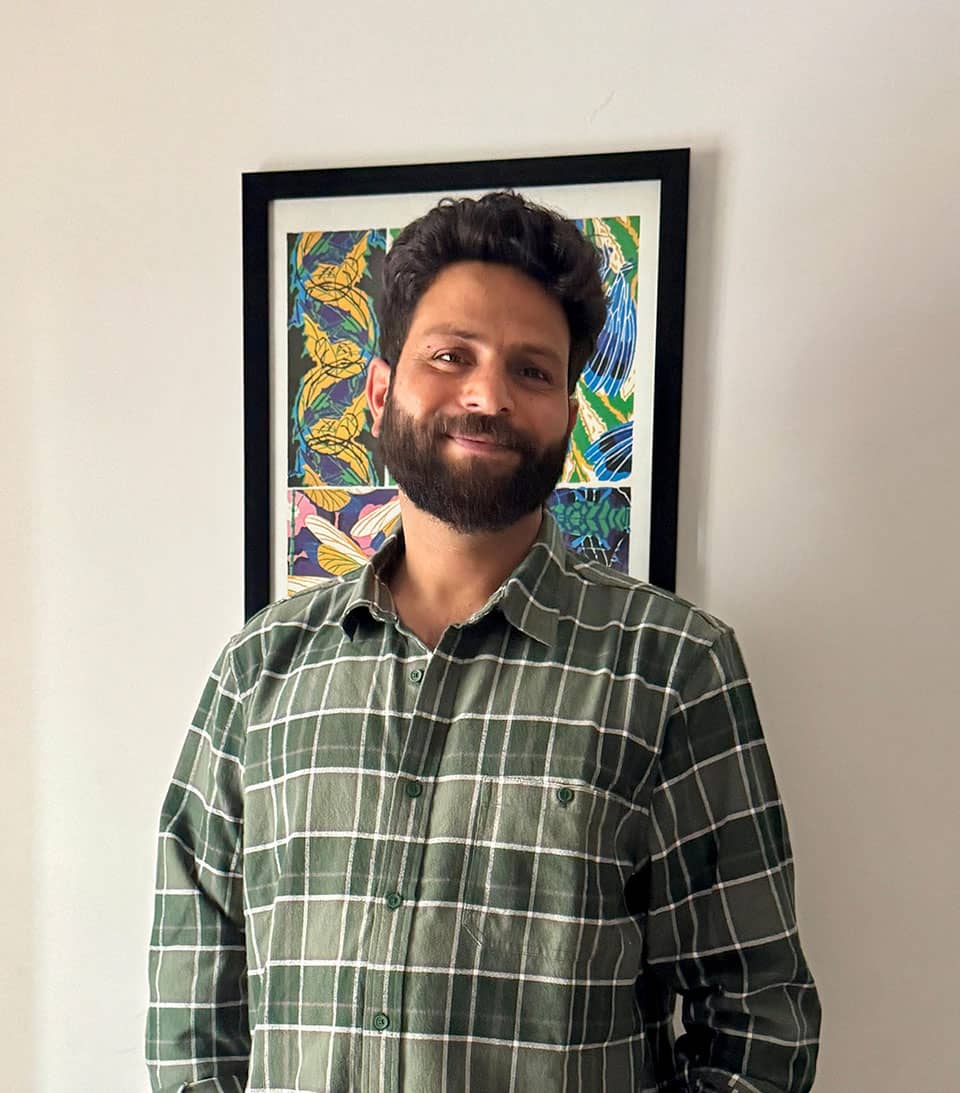
Nayeem Rather is an independent journalist based in Kashmir, reporting on identity, conflict and marginalized lives. His work combines long-form reportage with storytelling rooted in everyday experience. In his spare time, he imagines new stories while seated by the roadside, watching and counting passing cars.