

Conversations in the Blind School Dormitory - Storytelling Initiative - third edition
Conversations in the Blind School Dormitory
Conversations in the Blind School Dormitory narrativizes the conversations, daily interactions and lives in the girls’ dormitory of a school for the blind in Mizoram. The essay focuses on eight girls and their distinct experiences of blindness, and examines how they navigate girlhood and womanhood as blind individuals.
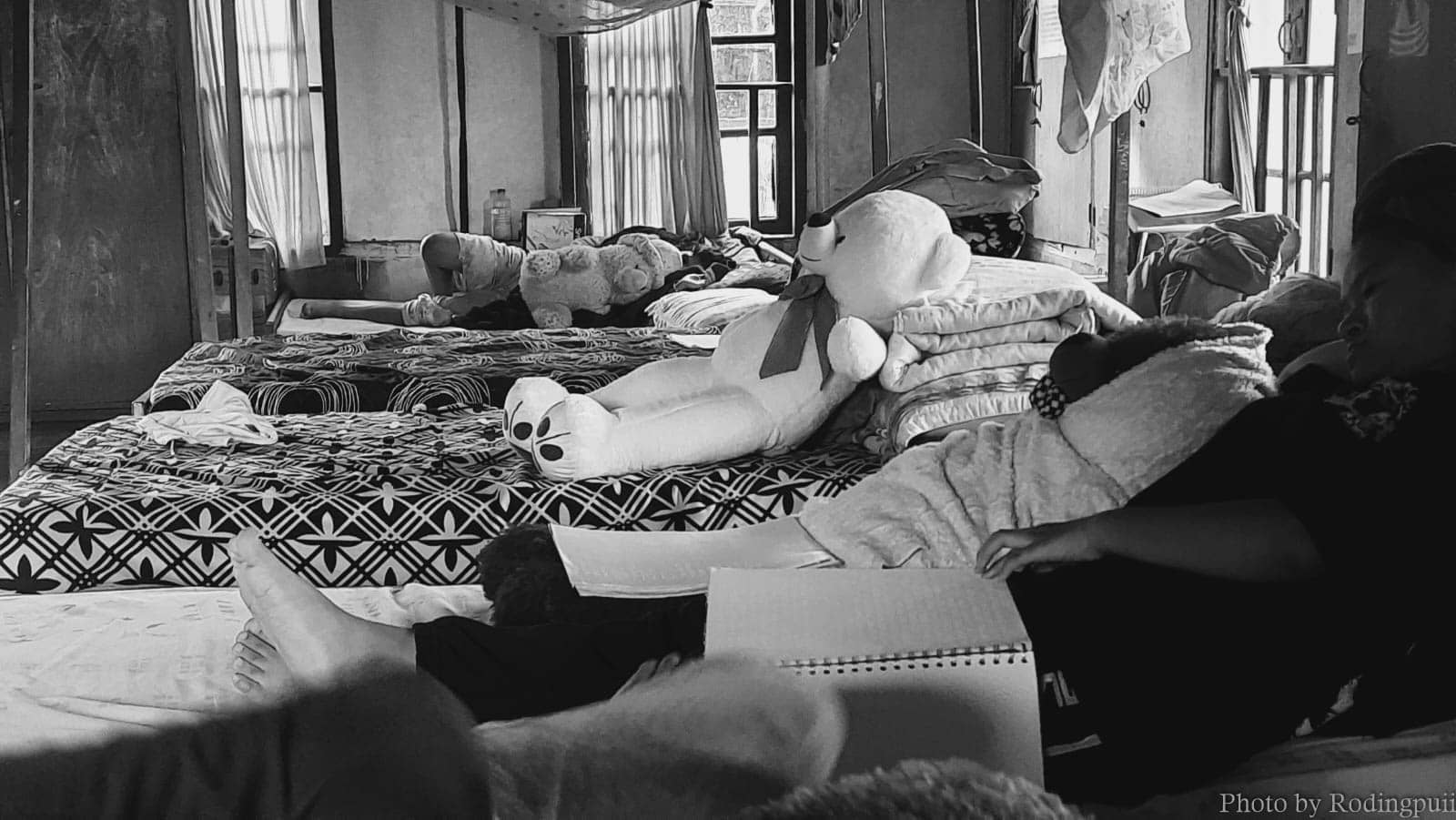
" Whose pants are these? This isn’t mine,” Celestine announced to the room as she was sorting her dry laundry. Fifi, seated on the next bed reached over, touched the piece of clothing and inspected it a few inches away from her eyes. “It’s not mine either,” she said and set it aside. This was about my tenth visit to the girl’s dormitory of the Special School for the Blind, Aizawl, and I am always intrigued by this diligent process of segregating clean laundry amongst the girls who recognized their clothes by touch, by the feel of the fabric and even smell. Each piece of clothing, each handkerchief down to the last right sock always goes to the right owner eventually.
The girls are meticulous and particular about their clothes. Especially Dorothy, who designs her own dresses. She had told me, “I’d go to the tailor and describe in real detail the kind of design I want.” Based on what is popular online and their personal preferences, the girls of this dormitory have continually updated their fashion sense along with the outside world. Right from the very first conversation I had with these girls, I felt that they knew more about the ‘normal’ people than what the ‘normal’ people knew about them. They also knew what ‘normal’ people knew and thought of them. The first thing on the girls’ list of ‘What they find surprising about us’? Their sense of aesthetic and personal taste.
When Dorothy, the straightforward and outspoken 22-year-old claimed, “They think we just about exist”, there was no room to defend ‘them’, because it was not an accusation. It was her observation of reality and the summation of the limited understanding and awareness we have of people with disabilities.
In one of my earlier visits, I had a long conversation with 19-year-olds, Hriati and Rabina. Rabina told me, “We do not mind being asked questions about our blindness, but some questions are real stupid.” ‘Like what?’, I asked. “Like ‘How do you poop’?
“Seriously, who asked you that?”
“We wouldn’t mention the name of the school. They were nurses from one training school and visited us a few days ago. They also asked us how do we eat?”
Eileen, who had just finished her hour-long bath-cum-laundry session, joined the conversation from two beds over.
“They also asked how do we bathe, though I’d say that one is a bit more reasonable.”
Dorothy, sleeping three beds over declared with her usual loud voice, “When people ask me that kind of questions, I’d reciprocate and ask “Well, how do you poop?”
In 2020, a viral video circulated throughout the Mizo community on different social media platforms. The video had five young women singing a gospel song ‘Parmawi Khawvel.’ The chorus of the song goes:
Though life does not blossom for me, there is no reason to complain.
The loving God is with me and never leaves my side.
The grandeur of life will no longer hold a place in me.
I eagerly walk towards the great kingdom each day.
What garnered interest in the video was not only the brilliant vocals, but the fact that the five girls were blind. The comment section was a plethora of paternalistic and spiritually laden remarks. When I visited the hostel for the first time in 2023, I realized I was meeting the girls from the video and learned their names for the first time - Khawtei, Agnes, Manuni, Eileen and Rabina. (Eileen and Rabina are still at the hostel while the other three left in 2024 to pursue high studies or start new jobs). It dawned on me then that while the clip of their singing had been shared and reshared a million times, they were known only as ‘the five blind girls singing.’
When they talked about the video, they explained amidst laughter, “We are not spiritual like people assumed. We were just singing”. The Mizo society that has adopted the biblical term ‘Vohbik’ (anointed) to refer to its disabled individuals might have a question or two about this casual remark that debunks the rigid cultural association of disability with religiosity. We, as a society do not ask enough questions about, for and to the disabled community. This story was born out of hundreds of questions and many hours of conversations in the girls’ dormitory.
On my third visit for the year 2025 in July, the monsoon mist had thickened along the winding slope of the Bawngkawn–Durtlang road, lined with scattered sites of minor rockfall and soil erosion, on one side, and the unobstructed if hazy view of the western horizon and mountains, on the other. Located on the northern edge of the Aizawl city at a relatively higher altitude, the Durtlang territory welcomes me with a distinct chill in the air. I eventually reached the backroad to the secluded locality of Durtlang Venglai and arrived at the Special School for the Blind signpost. The location of the school seems to reflect precisely the marginal space that disabled people occupy in this city.
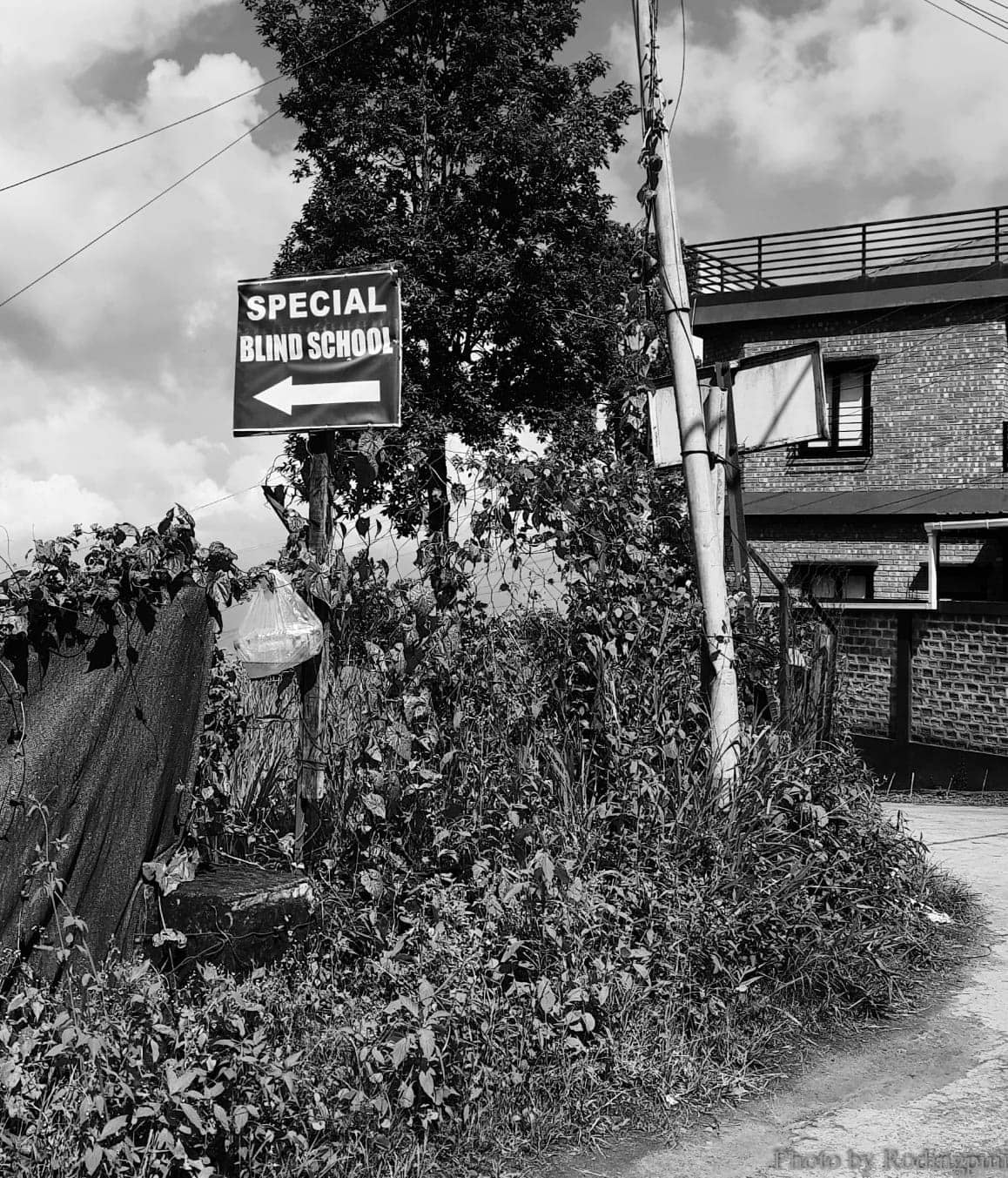
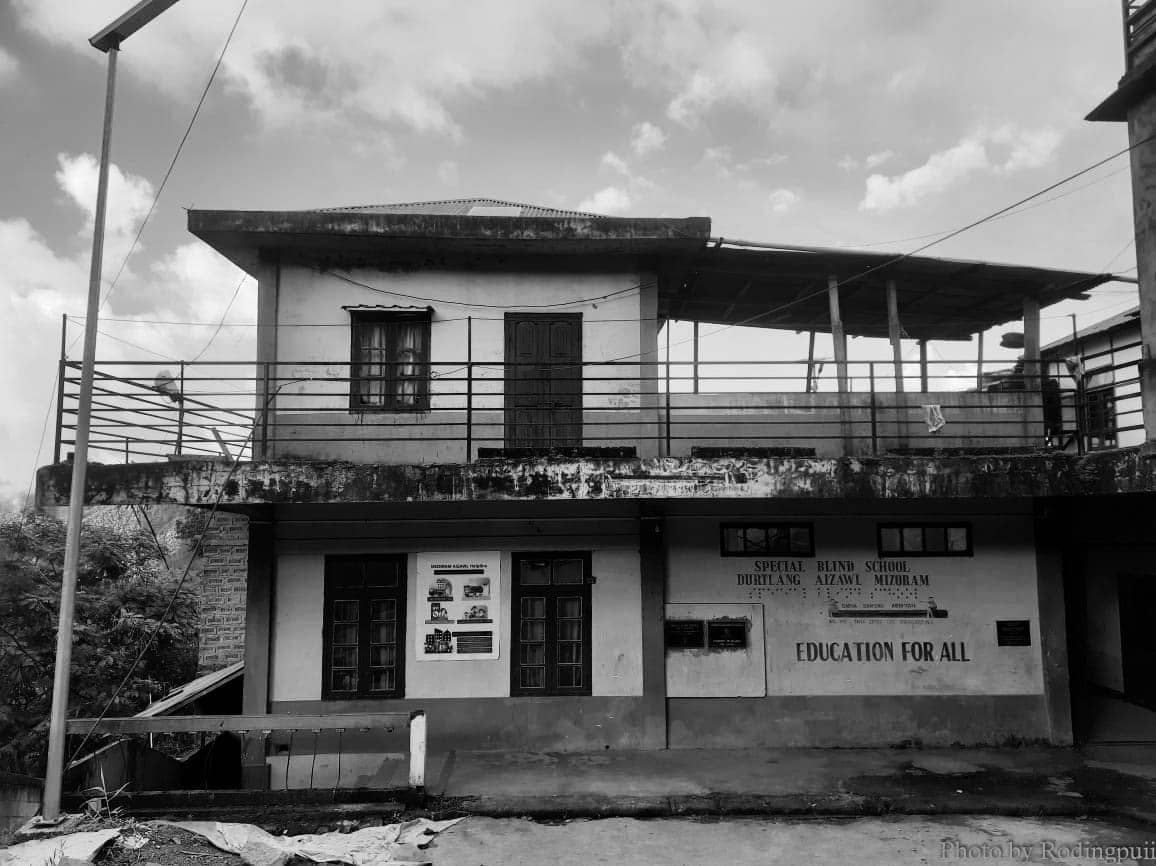
Established in 2001, the Special School for the Blind is a co-ed boarding school that provides ‘free food and lodging,’ and is run by an NGO, the Samaritans’ Association for the Blind (S.A.B). In Mizoram, a state of over 1 million people and nearly 7,000 visually impaired individuals, the school remains the only educational or residential institution for the blind. On an average, it has about 30 hostel residents who come from different parts of Mizoram and sometimes from the neighbouring states of Manipur, Assam and Arunachal Pradesh. In most cases, the children or adults who seek admission here belong to low-income and extremely poor families. Even if the student is done with their education and is not engaged in any training or employment, they can stay in the hostel as long as they wished. Thus, the age range of the students vary from 6 to 50.
After two decades, the interiors need renovation but I am told the school doesn’t have funds for it. Despite the rundown building and poor infrastructure, the students live and move in every nook and corner of the building and its surroundings with a sense of belonging. The school is situated amid lush greenery, mist laden hills and tall, slender trees. The chorus of birds singing, roosters crowing and the rustling of leaves fill the quiet spaces of the day. Just south of the hostel is the school field where the students play all kinds of sports, including football, cricket and shotput.
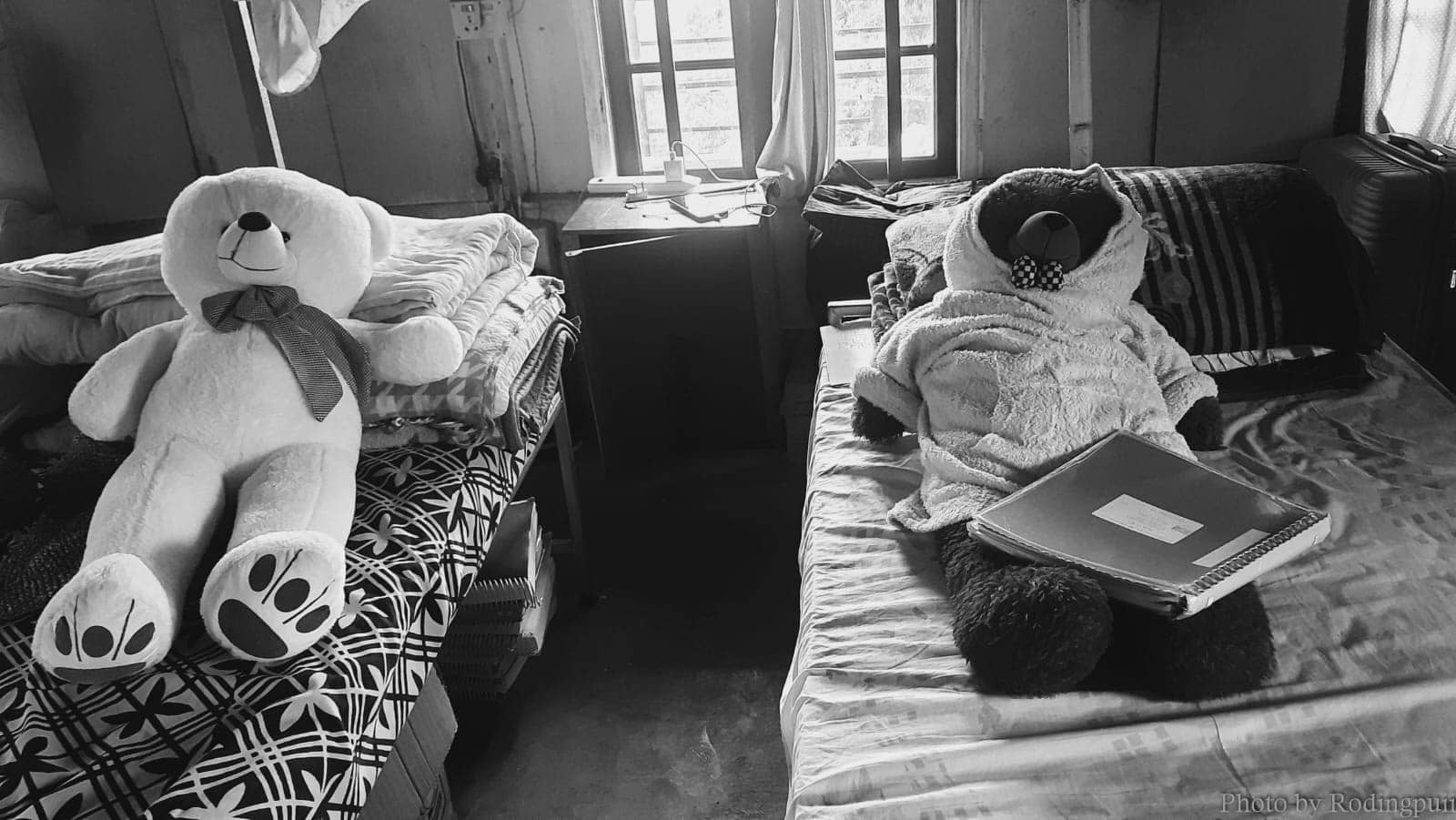
The girls’ dormitory is on the roof of the two-story building, and it is here that I meet the twelve young girls and listen to their conversations, their banters, their jokes, their singing and their stories. It has grey-tiled walls, grey cemented floors, tin roof, two outdated creaky doors and three south-facing windows. A row of six beds aligns each side of the wall and two beds make the middle row. There are no curtains or partitions, and every corner of the room is visible from the doorframe. The backdoor opens to a narrow verandah with a toilet and a bathroom. Three lines of long laundry wires run across the verandah which is almost always full with fresh laundry.
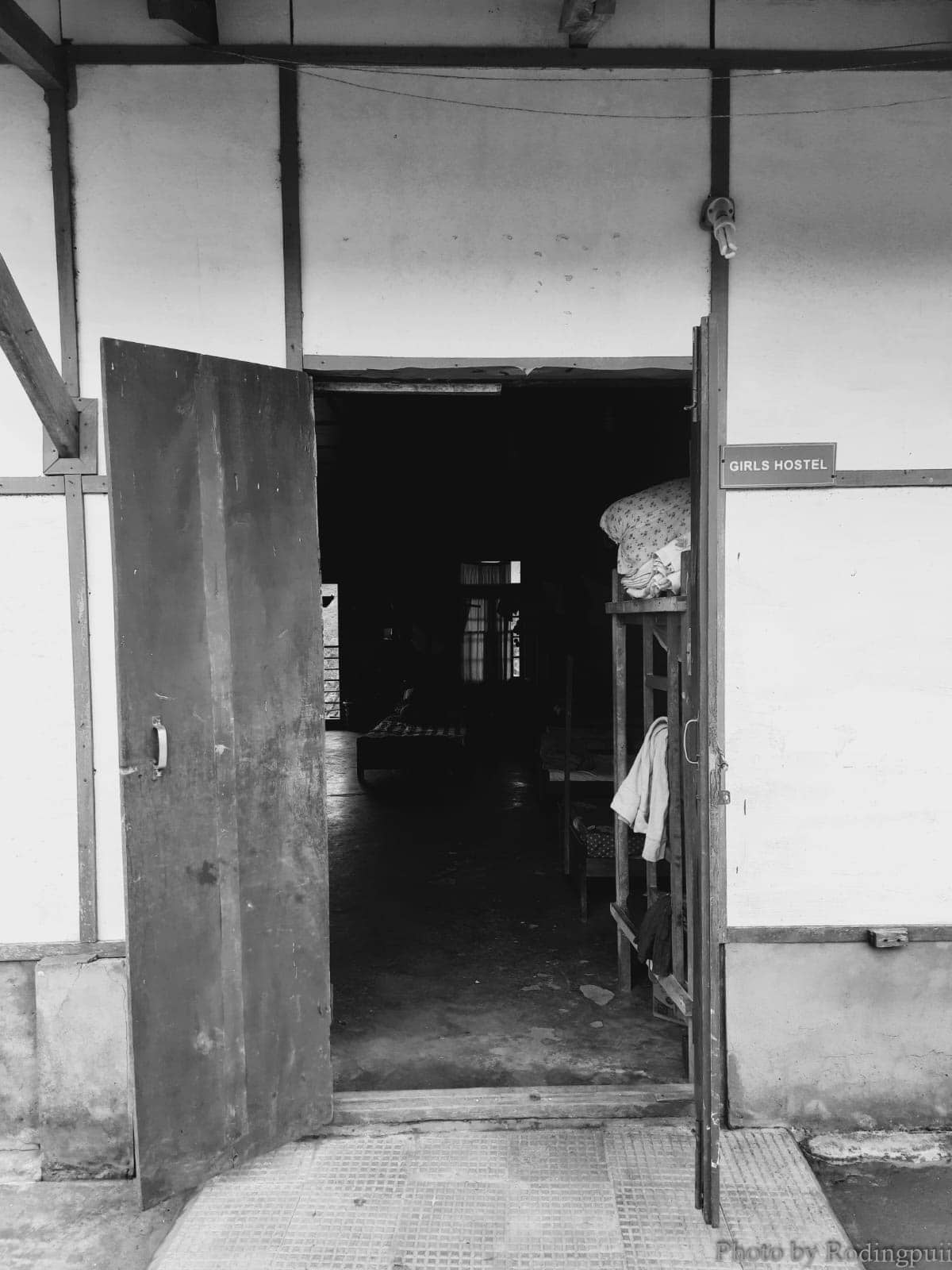
The girls usually start their day at 5 in the morning. For the next two to three hours, the dorm is busy with girls taking turns using the bathroom, getting dressed, preparing for devotion, revising their lessons, eating breakfast. Between 9 and 2:30 in the afternoon, the dorm is empty except for the warden and the three women who are done with school. When the girls return from class, they spend the rest of the evening winding down and relaxing. They leave their assignments and notes for after dinner, which is served at 4:30 pm.
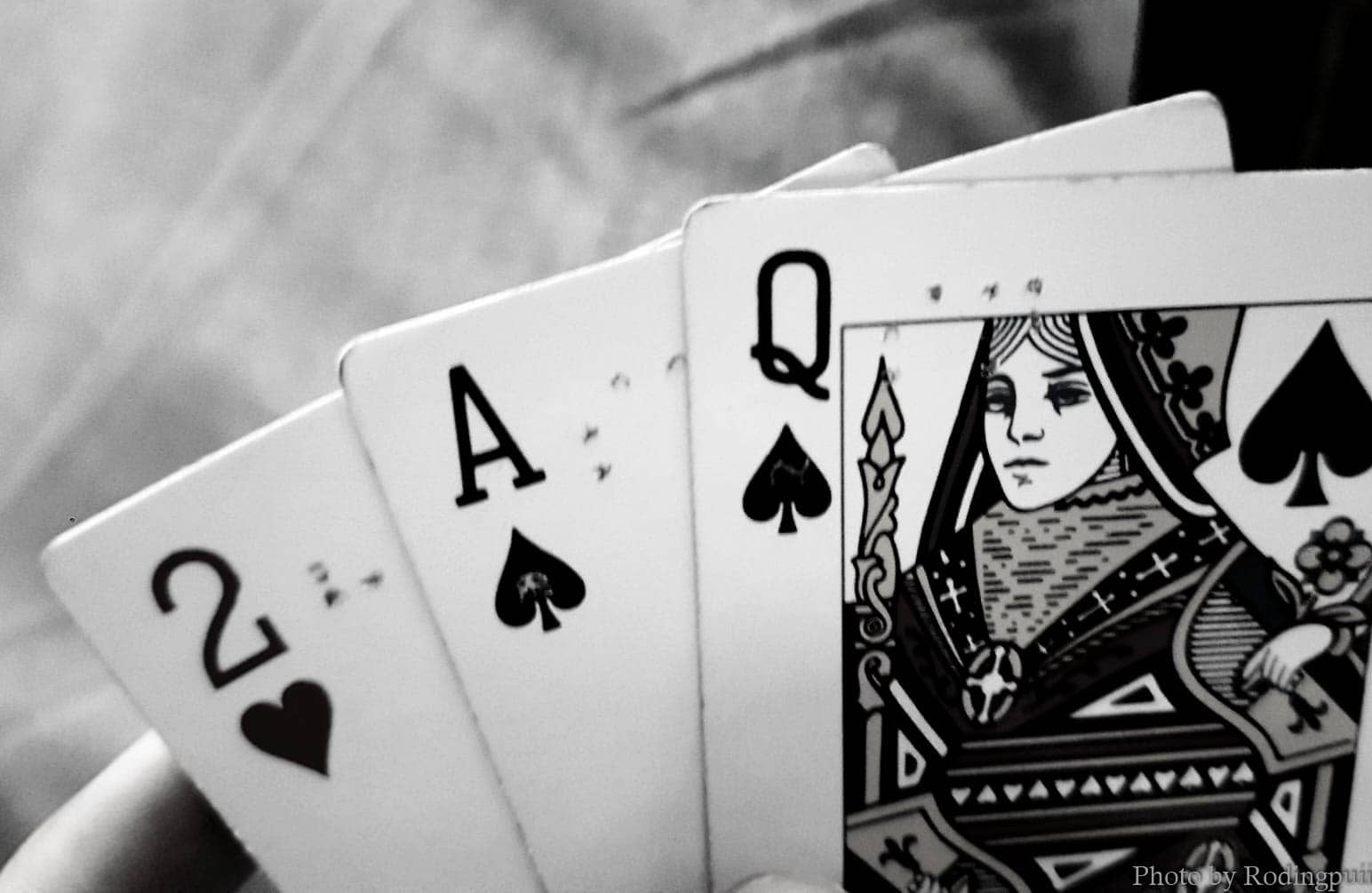
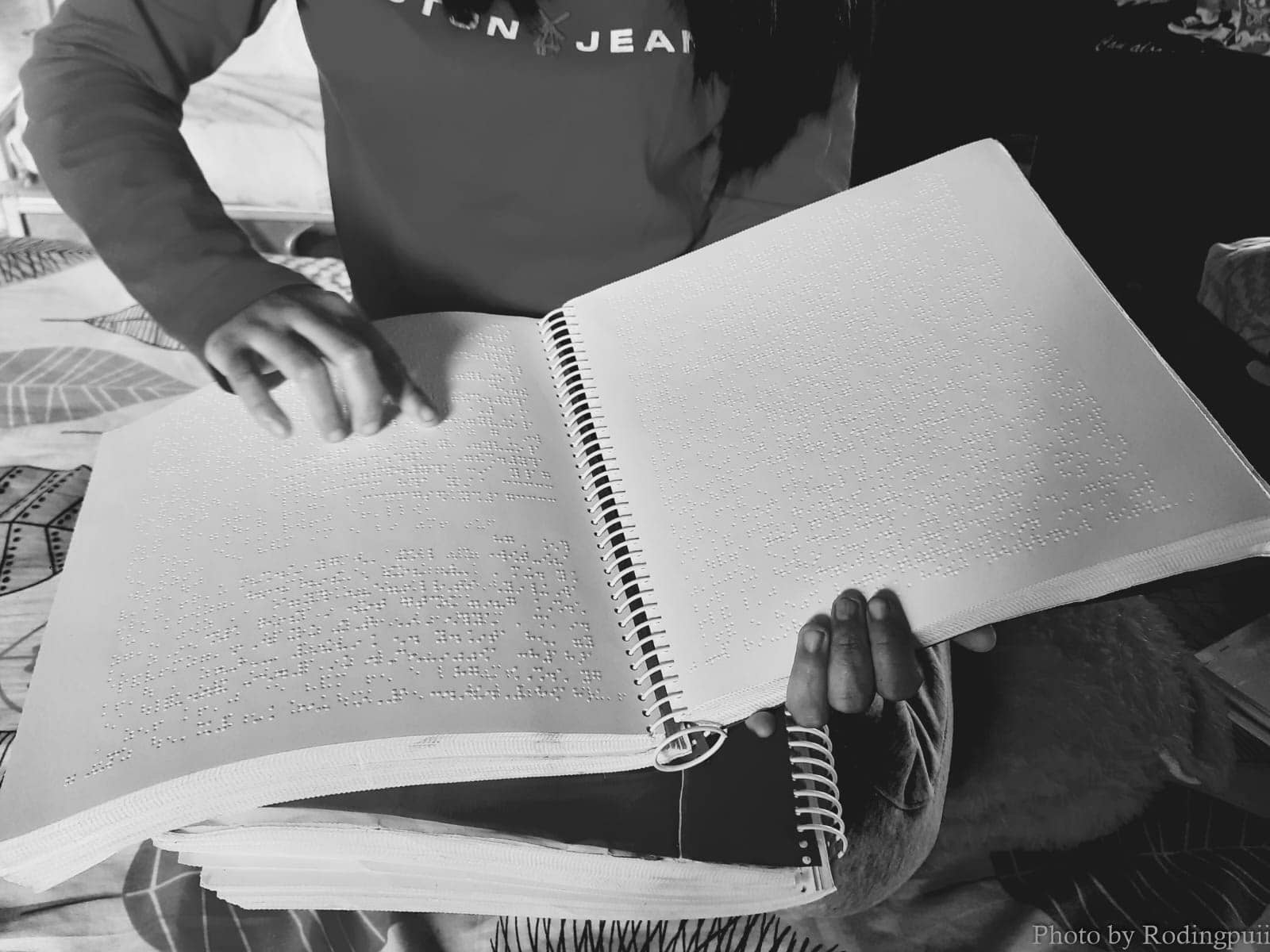
When the young girls take any offense towards the how-do-you-poop questions, they say that their annoyance is tempered with the understanding that people’s ignorance towards their lives was forgivable — “There’s just been very little awareness”. It was difficult to imagine just to what extent disabled people adapt to a non-adaptive world, with how much resilience and creativity. I had my own journey of learning and unlearning about disability within this dormitory. The first time I saw the girls playing with Braille playing cards was a revelation. The tactile dots allowed them to play card games without any constraints. Since then, I have watched them play Inlungvawr, a tricky game of throwing stones, and also carrom with an adapted board.
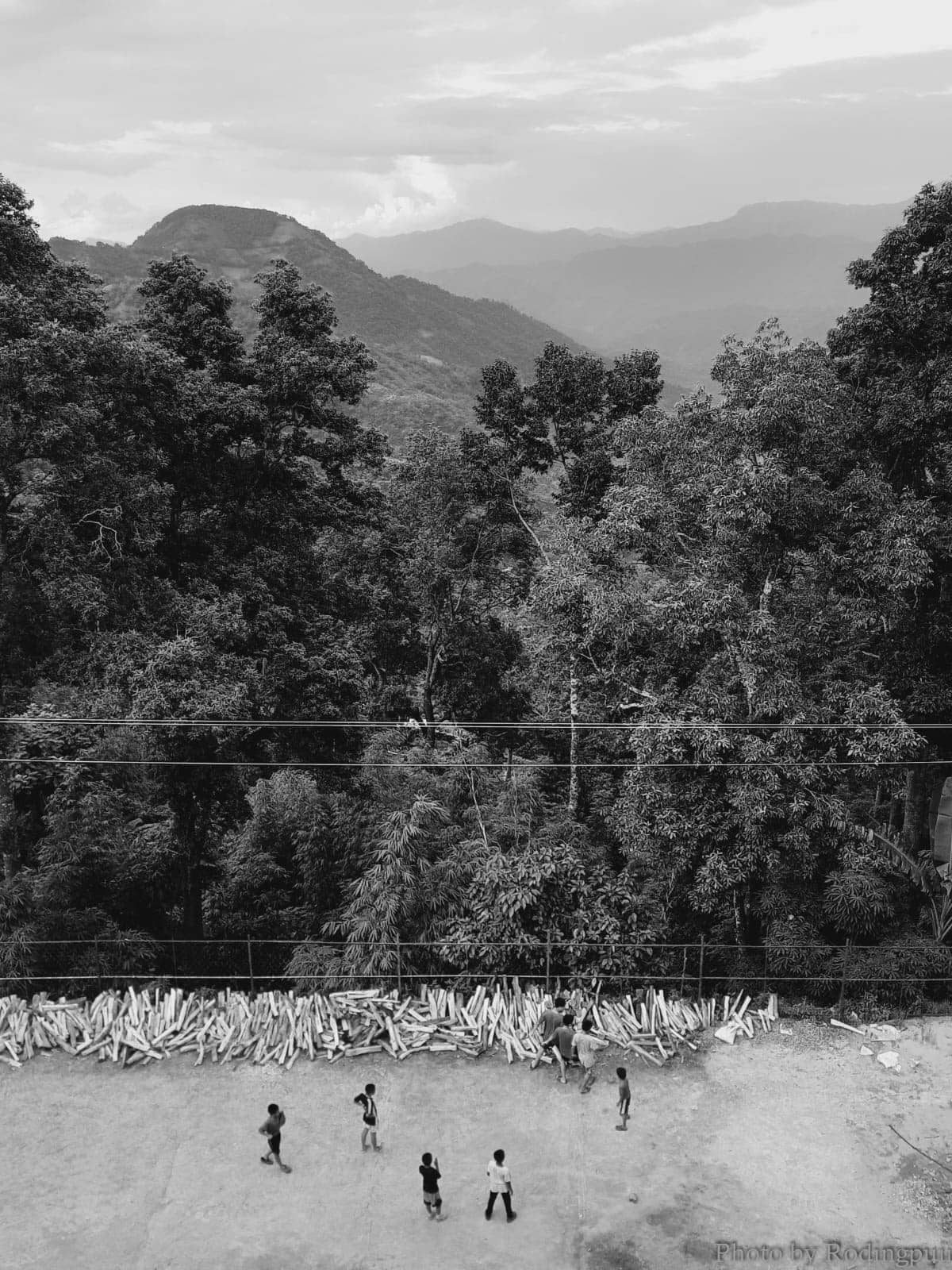
“Do you know we collect firewood too? The pile of logs in the playground, you’ve seen it right?” Hriati asked.
I had seen the pile of wood. It turned out they were used for cooking in their kitchen. The girls said that cooking was the one activity they did not partake in. There was no formal rule against it, but the task of cooking for over 30 residents was considered exhausting for the girls. The kitchen was filled with sharp objects and tools, needless to say the hearth where the fire burned. For these reasons, the cooking duty naturally fell into the hands of the boys. Dorothy clarified, “Of course, if circumstances demand it, for instance, back in my hometown, if my family are all travelling and I am in the house alone, I cook.”
The girls have several stories to tell about how they have been exempted from responsibilities, just as well from their rights, simply because they could not see. Hriati and Eileen shared their experience at the higher secondary school where they would continually be excused from sweeping duty and other physical activities. “That’s why I miss Sir Zuala” Eileen added. “He treated us no different than the rest of the class, and would punish us if we are late or submitted incomplete assignments. We prefer to be included like that.”
Eileen is an excellent singer with a distinct, husky voice and had continuously ranked first at her school’s inter-house singing competition. She has an effervescent vibrant personality, and a clear set of goals about the kind of future she wants for herself, which first and foremost includes leaving Durtlang.
“I have nothing against Durtlang”, she enunciated, “but I want to live in other places too.” Eileen was born with visual impairment in Chawrei village at the border between Assam and Mizoram. She was admitted to the Special School for the Blind at eight years old, where she learned two new languages, the Mizo language and the Braille script. A decade of her life has passed in this dorm and this locality and now she is outgrowing both. Once she passed her Class 12, she wishes to join college, stay in a regular hostel, meet new friends and have a brilliant, youthful college life.
“Here”, she said, referring to the school, “We are completely detached from the normal world/real life. You know the slang (she said with reluctance because this piece of Mizo slang is deemed impolite); ‘I hmel a nih chu’ In your face, which was commonly used about five years ago? We just now heard about it”. I laughed at the unexpected example. “We are not up to date with the comings and goings of things. I feel we are behind everyone. We have phone and internet access, but it’s not the same as lived experience. That is why I am eager to leave and start a new chapter.”
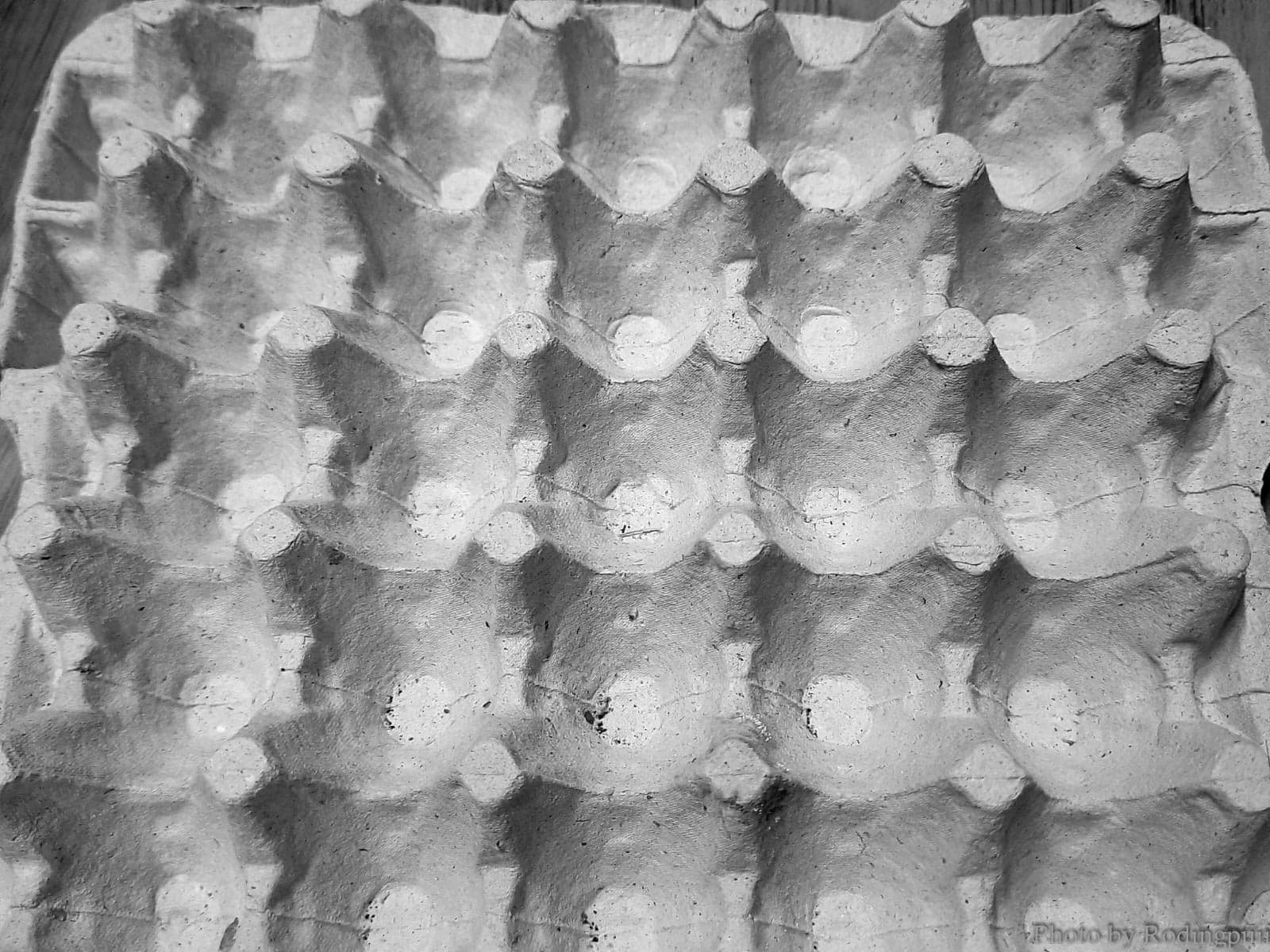
Hriati is another wonderfully vibrant nineteen-year-old. She is from Serzawl village in Mizoram and was admitted to the school when she was 7. Having dealt with skepticism and accusations about her partial blindness for most of her life, Hriati feels the school is the only place where she is fully understood and accepted. She is able to see to some extent in broad daylight but continuously experiences painful eye strain and headaches. In a dark room, improper lighting or at night, she completely loses her vision. Upon her admission to the school, she began to learn Braille. In the beginning, the script was too small for her to discern so she practiced on the back of a cardboard egg tray with bigger dots – a makeshift enlarged version of Braille.
In every conversation I’ve had with Hriati, she emphasised the lack of understanding of disability as a vibrant spectrum that is experienced differently by each disabled individual. The lack of understanding and the need to understand. Hriati has not been considered ‘normal’, but she was refused the ‘disability’ identity by society. This posed further difficulties in her navigation of the disability experience. The ableist society that hardly fathoms the complexity of disability was yet to understand her condition as ‘partially blind’ and will only take a definitive answer to the question “Are you blind or are you not blind?”.
Hriati also mentioned her and Eileen’s struggle at making friends in school. “Nobody is unkind to us, and nobody is really our friends. Friends are really important for us blind people, someone to drag us along and include us. But all the issues and problems we encounter have already been experienced by our seniors before, so that inspired me to not take things personally.” All the girls and by their account other residents who had lived in the hostel before, struggled to establish connection with their sighted peers. Friendship, relationship, crushes and marriage are topics that are constantly brought up in our conversations, often while joking, teasing and with confessions. When I brought up the topic of marriage, the girls were open about their desires.
“I certainly want to get married”, Hriati said. “We need someone to take care of us when we get older, and our family might not be around forever.”
“But he will have to be extremely understanding and patient,” Eileen said.
“And his parents too,” Dorothy added. They named three of their seniors who had got married to husbands without visual disability and were now mothers of sighted children.
A few days later, I asked Es-i the same question while we were alone in the dorm, as the other girls were in class. She is 35 and the eldest resident in the dorm. Perhaps because of the age gap and her general air of reserve, she does not mingle much with the girls. I usually find her sleeping in her bed in the corner. She never talks much. “I do not think about marriage that often,” she told me. “I can barely provide for myself, so I cannot imagine having children.” It has been nearly a decade since she passed Class 10, and despite having undergone training in computer skills and as a masseuse, it has not been easy finding work. He told me about Muanpuii, a girl who used to live in the hostel. Muanpuii completed a training course in massage therapy and was employed as a masseuse by a salon owner in the city. Along with the job, she was offered food, lodging, and a guide to accompany her. Esi hasn’t had similar opportunities.
Before coming to the blind school, Es-i was in the Moria Blind School, a residential institute till the school and residence was shut down n 2013. Some of her classmates from Moria have gone on to pursue higher studies. Some have taken up jobs as ‘street singers.’ In the Mizo social psyche, 'street singing' by a blind person is often dismissed as begging and has never been considered a legitimate job. But as Es-I shared her stories and experiences at Moria Blind School, it became evident that, for her and her peers, street singing was one of the few viable employment options available to them, given the severe lack of opportunities or the substantial support to explore other vocations. Es-I’s world felt smaller than the rest of the girls’ and her dream was painfully modest.
Extroverted and carefree Dorothy is Es-I’s younger sister. The sisters are from Siaha district and their blindness is congenital. Before coming to the special school at the age of xx, Dorothy did not receive formal education. She was allowed to attend the village public school without admission fees, school uniform or exams. Dorothy said that, when she first came to the blind school a year after Es- was admitted, she could not even spell basic words like Monday, because she never learned the alphabets and she had never written or spelt anything. Everything she knew was only what was read to her by her friends in class. The blind school was a beginning for Dorothy. At twenty, she studies in class 7, has an exuberant and straightforward nature. She loves YouTube where she listens to Mizo audio stories. She is observant and imaginative She told me that she imagines a person’s appearance based on their voice — from their make-up style, their hairstyle to their neckline. In general, the girls’ evaluation of a person’s appearance is based on their voice, their smell and their height.
“The thing is we can only imagine and picture what we have touched. I have touched all kinds of clothes, so I can picture it easily.” The other girls with congenital blindness affirmed Dorothy’s statement. “I’m really curious about how you imagine things, and what kind of things you imagine”, I said as our conversation went on the topic of imagination.
“You are curious about such a difficult topic”, Rabina sighed.
“Can you just be curious about how we eat?”, Dorothy added.
The girls admitted the question of how they imagine or daydream never came up, so it was a new conversation for them and amongst them. Some said they did not imagine much. Dorothy and Hriati said that in their daydreams, they picture themselves as ‘normal’ people.
“I used to drive a Scooty in my daydreams”, Dorothy said.
“I don’t think I have imagined myself with vision”, Eileen said.
“That is the same for me. It is just pitch black…even in my daydreams”, Rabina added.
This led me to ask the question, “When I say beauty or beautiful, what do you picture?
“Probably a pretty dress with pretty neckline.”
“Trees and mild breeze”
“The sound of a river, and sleeping in the meadow beside it”
“People always say flowers, but I have not touched enough flowers to perceive it aesthetically. I don’t understand how a flower can be beautiful”.
The girls engage in a long conversation about a list of things they have touched and not touched. Out of the list, one stood out. A bird. Rabina was the only one who had touched a bird. A dead one. For the rest of the girls, what they knew about a bird is that it flies and that its songs lend peace and serenity to their ears.
Later in the evening, Dorothy said she had a question which she thinks “might sound as absurd to people who can see”. The question was – “How do you see? You look at something and you just see it. Suppose someone stands there, will you just see them? For me, that is a very strange phenomenon…that you lay your eyes upon something and just see what it is.” Just as the question of ‘how do you picture things’ was difficult for them, ‘how do you just see things’ was a difficult question for me.
There was one other question that I and the girls tackled in hours of conversations – “Has blindness ever been cured?”. Amongst the Mizos, there is an undeniable historical and cultural obsession with the cure of disability. Each girl has a memory of a visit to a faith healer or an evangelist’s healing ministry. The rise of such religious association and obsession in contemporary Mizo society could perhaps be traced to the popularity of Evangelist Faktea and his touch-healing crusade in the early 2000s. The crusade recorded hundreds of healing testimony from people all over and even outside Mizoram, and included disability healing as well. Thus, the question of healing through faith is of great relevance within the Mizo disability narrative. However, the girls enunciated a unanimous observation that profound or congenital blindness cannot be cured, and it has never been. “There are cases where faith healers have successfully healed muteness or deafness, and even people with impaired mobility and other illnesses. But there is not one blind person who had been cured.” There was a silent affirmation in the room that blindness was a permanent disability that even an act of miracle could not rectify.
“What about U Khawtei?” Eileen asked. Khawtei had left the hostel in 2024 to work as a teacher in her hometown. Eileen was referring to the 2018 viral clip of an evangelist healing Khawtei at a healing crusade. In the video, the evangelist, standing a few feet away from the girl, said, “Come and touch my nose”, and she did. The girls had little to say about the incident except that the healing did not restore her vision to its ‘normal state’, and it was not permanent even if it had actually occurred, and Khawtei continued to stay in the dorm. Manuni, Khawtei’s batchmate, also recalled the many instances in her childhood where her parents took her to faith healers. In one instance, the healer put some handmade balm in her eyes, stinging her badly. When her younger sister, Fifi was born with the same disability, her parents had learned to accept it as a natural trait, and there were no more visits to the faith healer.
One evening in mid-August, I was sitting with Fifi, the youngest amongst the girls at 14 years old in the verandah watching or listening to the rain. She carried a Barbie in her hand and a fine-tooth comb in another. She has another Barbie in her lap. Fifi is the shyest out of the girls, soft-spoken and rarely speaks unless spoken to. And had I not got approved as ‘friendly’ by her older sister Manuni, she might not have opened up to me as soon as she did. She was in studying in class four, and claimed she was not academically gifted like her big sister, who had now gone off to the university to pursue her masters.
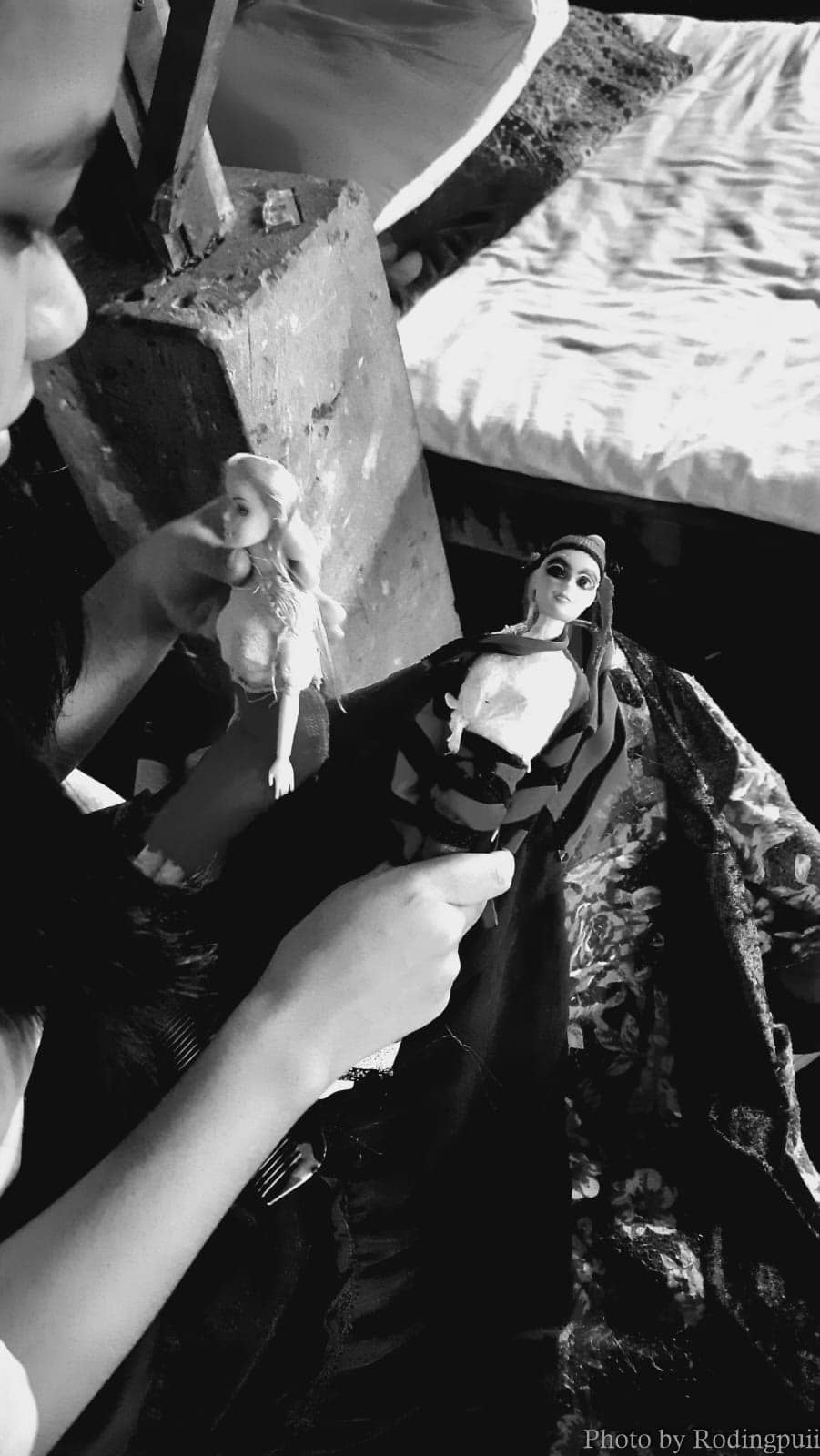
“What happened to this one’s hair?”, I asked, referring to the doll with the pixie cut in her lap. She nervously chuckled and told me she cut it herself. Both the dolls have grown colorful with paints and sketches all over their faces and bodies. Fifi also stitched clothes and headdresses for them. It was a favorite pass time for her. She does not yet own a mobile phone.
“If I had not been blind, I would like to become a tailor”, she told me.
“What do you dream of becoming now?”
“A teacher, maybe. But I don’t like studying…like my sister”.
Celest, on the other hand was an athletic girl, from Serzawl village. When she was around 6, she had an eye infection, and despite the medication and treatment, she continued to experience vision loss, till she became fully blind.
“Back in my village, even as I started to lose my sight, I did not perceive my condition as a bad thing. I was still allowed in the school even though I could not read, I could still play and run around the school yard, I could still go to the farm with my siblings. The realization came way later…when I learned I could not pursue my passion in sports”
Fifi and Celest, the two youngest girls came to the hostel about three years ago. They had since learned Braille, their lessons, how to use their phones to take notes and study, to take care of themselves, to adapt and adjust to their lives in the hostel. They do not yet dream of ‘becoming’ anything. Although they know they would have to find a way to make their own living someday, they have not yet figured how to do it. All they could dream of at the moment was limited to what had been done before by their seniors, so Fifi said she might study to become a teacher like her sister was now. Celest thought she could be a teacher or a teacher assistant in their school like their senior Ludy who completed her B.Ed.
As the ‘ber’ months arrived, so did the fine autumnal weather to make up for the bad temper of the previous months. The surroundings of the hostel grew ever more lush and serene. And the girls welcomed a new hosteller from Manipur.
Mercy was 21 and had come to Mizoram as a refugee, fleeing from the ongoing conflict in her home state. When I first met Mercy, she was singing alone on the balcony near the school library. Intrigued by the melodious voice singing a familiar Hindi song, I approached her and introduced myself. She had managed to speak an accented Mizo in a short time, although she said, she could not sing any Mizo songs yet.
Back in Manipur, Mercy attended a special boarding school for the blind, which unfortunately was located in the conflict zone. When the army arrived at the hostel with a warning to evacuate the building within the next 24 hours, she and the other boarders had no time to complain or address their despair and fear. Upon a relative’s suggestion, her parents sought admission to the Aizawl school, and thus began Mercy’s life here in the dorm, along with the other eleven girls.
After that first conversation, we talked privately a few times. But in most of my subsequent visits to the hostel, I would find Mercy sleeping with her head towards the foot of the bed, her long and voluminous curly hair touching the floor. She always had earphones on and softly hummed or sang a Hindi song. If not, I’d find her reading one of the big Braille textbooks. The other girls too, had not yet learned much about her because she mostly kept to herself and seldom joined in on our or their conversations.
“Don’t worry, we’re all like that in the beginning”, the girls assured me. “Some people need a few days to adjust. Some needs months, but it’s all the same because we all eventually come around.”
I took their word for it. They had left the safety of their homes at a young age, to learn to stand on their own and to adjust to the new world by themselves. These girls had grown up together in the one building outside the vast hilly city of Aizawl, a building where they enjoy total freedom and acceptance. I remember, in one of my earlier visits, the girls and I talked about some of the widely known Mizo disabled persons – a singer, a preacher, a professor…. Then Eileen told me in her usual joking and carefree tone, “You have to know U (big sister), we are not the successful kind of blind people. We are the ordinary kind of blind people”.
“Yes, we have no story of achievement to tell”.
“All we do here is crack jokes and sing. Don’t expect too much from us”
Eileen’s words make an important side note — a quiet disclaimer from the girls themselves, for the society that overlooks a disabled person but celebrates a successful disabled person. I had no intention of convincing this group of girls of their intelligence and awareness, that they were extraordinary. If I had, they would sneer at such patronizing acts without so much as looking away from me. So, I told them instead,
“The extraordinary stories had already been told anyway. Let’s hear yours”.
And thus began the many hours of conversations, in groups and in private, on the beds, the porch or the balcony of the building, all honest and all ordinary. I find it appropriate to end this on an ordinary note of appreciation and admiration for the ordinary girls of the special blind school, and their ordinary stories that had not been told before.
About the Storyteller
Roding Puii
Rodingpuii is a creative writer from Mizoram and is currently pursuing a Ph.D. in Disability Studies. Her experience as a caretaker has strongly shaped both her creative and academic engagement with disability representation, awareness and inclusion. She views storytelling as a vital medium to amplify voices from the margins. Writing under the pen name 'rdp', she also publishes poetry.